

The Bible: Choosing a Bible: A User’s Guide
Before you begin your Bible study, take some time to choose your translation.

A friend from Japan was telling me about the Japanese version of the Bible he uses. He turned to Luke 5:39. In the New International Version this scripture reads, “And no one after drinking old wine wants the new, for he says, ‘The old is better.’” My friend told me: “My Japanese Bible does not say ‘wine.’ It says ‘sake’ [a Japanese beverage made from fermented rice]. Since new sake is better than old sake, the verse goes, ‘No one after drinking new sake wants old, for he says, ‘The new is better.’”
At first glance, that translation seems the opposite of what Jesus said. He said the old was better, not the new. Also, Jesus said wine, not sake. Wine is usually better after a few years of aging. Sake is better when it is fresh.
Why did the translators use the word sake instead of wine? My friend explained that in Japan, few people know about wine. Thus, the translators of the Japanese Bible were faced with a choice. Either they translate the verse literally, and confuse their readers, or they translate the verse more freely, and communicate Jesus’ intent.
In this verse, Jesus was contrasting the old legalistic form of religion with the new form he brought. In English versions the old and new wine is a metaphor for these two forms of religion. In the Japanese translation, the sake metaphor conveys Jesus’ intent of there being a difference between the two. Ironically, if the translators had chosen the literal rendering, Jesus’ intended meaning would have been lost for the Japanese readers.
This story illustrates a dilemma that continually haunts Bible translators. Should they translate as literally as possible, and risk confusing the reader, or should they translate the intent of the Scriptures, and thereby lose some of the original meaning?
Literal vs. accurate
As Christians, we value the Word of God, and our natural instinct may tell us to trust only a literal translation of the Bible. “When people say they want a literal, word-for-word translation,” says Ken Barker, “they are thinking that more literal equals more accurate.” Barker is executive director of the New International Version (NIV) Translation Center in Lewisville, Texas.
“Being literal is not the same thing as being accurate,” says Barker. “A completely literal translation would be awkward, confusing and sometimes misleading.” For example, a literal English translation of Jeremiah 12:2 would read something like, “You are near in their mouth, but far from their kidneys.” In Hebrew, the kidneys represent a person’s seat of emotions — the heart, as we would say in the English language. The King James Version, translating literally, used reins, a virtually forgotten term for kidneys.
The New International Version (NIV) translates this verse, “You are always on their lips but far from their hearts.” This translation, though not literal, captures the intent of the original. The New King James Version (NKJV), completed in 1982, updates the original 1611 version and smooths some of the awkward, word-for-word renderings. Still, the NKJV can be difficult to read. For example, in Job 36:33 the NKJV says, “His thunder declares it, the cattle also, concerning the rising storm.” Though this improves on the 1611 translation, you will probably have to read the passage several times to catch the meaning. The NIV translates this verse, “His thunder announces the coming storm; even the cattle make known its approach.”
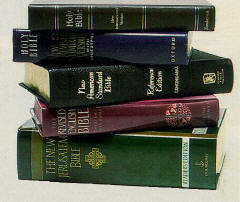 An example from Paul’s writings further shows the differences between these two translations. The NKJV translates Romans 8:8, “So then, those who are in the flesh cannot please God.” This translation is literally accurate, but not as immediately understandable as the NIV’s: “Those controlled by the sinful nature cannot please God.” The NIV is closer to what Paul meant. He was using the word flesh as a metaphor for the sinful nature.
Translators of the NIV steer the middle course between the literal, word-for-word and the freer, thought-for-thought translations. When recommending a Bible version for the average person’s main study Bible, Professors Gordon Fee and Douglas Stuart wrote, “We would venture to suggest that the NIV is as good a translation as you will get” (How to Read the Bible for All Its Worth, 2nd ed., page 43).
A matter of textAny Bible version’s accuracy depends on more than its translators’ skill. Accuracy also depends on the translators’ choice of the original Bible text. Significant advances in textual studies have been made since the 1611 King James Version. Though the translators of the New King James Version cleared up some of the old version’s awkward, word-for-word translations, they essentially relied on the same New Testament Greek text that the translators back in 1611 had. “The King James translators had seven Greek manuscripts of the New Testament available to them,” says Ken Barker. “Today, we have more than 5,000 manuscripts and papyri discovered since 1611.” According to Barker, these manuscripts differ in only 2 percent of their texts. The majority of these differences are minor. The spellings of names or the word order of sentences can differ. However, some differences are significant. Though these text variations seldom affect theology, they do affect the meaning of various verses. The translators of the versions recommended in the accompanying article preferred to choose the most accurate text of each Bible verse, rather than stick with a traditional, yet incorrect, reading. |
Tips on translations
Still, when you use any Bible version, you are reading God’s Word in translation and losing some original meaning. Though translators deeply respect the Word of God and strive to be accurate, they admit that no translation or translator is perfect.
Preferences of the translators, including their theological biases, inevitably appear. Thus, just as they have been careful in translating their version, they urge Bible students to be careful in using it. For this reason, you will learn more in your Bible study if you regularly consult other versions. A good technique is to refer to at least two other Bible versions — one of them more literal and the other more thought-for-thought.
A literal translation generally takes more time to read because of some awkward wordings. However, with it at hand, you can confidently explore other translations, knowing you can always refer back to the more literal wording. A literal translation also preserves original figures of speech and poetry. Freer translations, aiming to convey the intent, can weaken a biblical writer’s literary style. You miss more of the original flavor.
Good literal versions based on solid textual study are the New Revised Standard Version, the Revised Standard Version and the New American Standard Bible.
Freer translations
On the other hand, freer, thought-for-thought versions often have a natural, easy-to-read flow. They enable you to easily read a book of the Bible in a few sittings to get an overview of what is discussed.
Freer translations can also be quite thought-provoking. They convey an emotion that may be lost in more rigid translations. Good thought-for-thought translations are the Revised English Bible, the Jerusalem Bible, and the New Living Translation. Paraphrases such as Eugene Peterson’s The Message Bible can also be helpful.
With a middle-of-the-road translation, like the New International Version, as your regular study Bible, you can confidently explore other translations to enrich your understanding of the Scriptures. Comparative Bible study using several different translations allows God’s Word to speak to you clearly — even in translation.
Author: George Hague
